Showing posts with label The Drawing Board. Show all posts

Monday, November 7, 2011

Blessings

Cara 102011Cara” – work-in-progress

Copyright 2011, Valerie Jones


This past week I have been awakened to all the blessings in my life.  It’s a wonderful, peaceful feeling that has washed over me as I think about all the people who have walked along side me.  Life on earth can be a pleasurable journey.

Above is a graphite drawing of “Cara”.  She was one of our models while at The Ryder Studio.  I am teaching the method of drawing that I learned while there.  I have seven amazingly talented students who are learning how to draw “Cara”.

Monday, October 31, 2011

Mr. Parker – Complete

Mr. Parker

Copyright 2011, Valerie Jones


I delivered this finished drawing to a happy client today!

Monday, October 17, 2011

Mr. Parker – Week 2

Mr. Parker 101711

Mr. Parker – Work in Progress

Copyright 2011, Valerie Jones

As I begin Week 2 of working on Mr. Parker, I find myself smiling back at him!  Do your paintings and drawings talk back to you?

Tuesday, October 11, 2011

A Peaceful Calm

Mr. Parker 10112011  Mr. Parker, Work-in-Progress

Copyright 2011, Valerie Jones


Ever have a day when you want to draw and all your pencil strokes come out choppy?  I had such a day recently.

What did I do to remedy the problem?  I took a scratch piece of paper and practiced only pencil strokes.  As I practiced, a rhythmic feel came over the pencil strokes.  As my pencil strokes calmed, so did my breath.  Everything seemed to work better.

What kind of technique do you use when you need to create a peaceful calm to draw?

Monday, September 19, 2011

The Ryder Studio – Day 10

Ryder Demo Day 10 - Hair smCopyright 2011, Anthony Ryder

Day 10

The Ryder Studio

Santa Fe, New Mexico

The last day of my experience at The Ryder Studio…an awesome time of learning.  I was saddened to see it come to an end.  I am looking forward to returning again in the near future!

We learned about drawing hair on the 10th day.  The hair is sometimes darker than skin tone and sometimes lighter.

Hair is just another form.

The border of the hair on the head is very important to get.

Don’t draw the block-in as a generic form.  Draw it as an appearance of what the person looks like.

Look for the hair shape during the block-in.

Continue the scalp with an imaginary line through the hair to  help create the form shape.

To some degree, the hair clings to the head, like a cap.

Hair naturally groups into locks.

When things overlap, use a T-intersection.  Same goes for the hair.

We all know what it feels like to put your hair behind the ear.  Make that feeling happen.

The locks of hair are sort of glued together, in a sense.

After the shape block-in of the hair, then add the placement of the locks, each with a certain convexity.

For short hair or hair challenged people, draw forests of hair with meadows in-between.  Crew cuts, etc.

Hair is glossy and shiny – as it arks up and turns, it reflects a highlight.  As it turns back down it starts to darken again.

The highlight cuts across the shape of hair in a different way than it does on the face.

Shapes of shading are shaped like tornadoes.

After the block-in and shape placements, then add tonal washes.

The highlights in the hair follow the shape of the light on the forehead.

The terminator of the jaw-line follows into the hair.

When hair falls into the shadow, you have a less-see zone.

Remember not to over-define areas in the shadows, draw only what you see as accurately as you can.

Hair casts shadows on the face.

As hair is not solid, the cast shadows are not solid.  They sometimes are fuzzy.  ie:  dappled sunlight on the sidewalk from a tree at sunset.

Draw hair in a scruffy fashion instead of smooth and silky.  If you are having a bad drawing day, draw some hair.

Hair falls vertically at a faster rate than hair falls horizontally.

Hair has a certain spring to it.

When the curl sits on a shape it curves differently.

Leave the highlights the white of the paper.

Think of mixing eggs for scrambling when applying the pencil to the paper.

Value is an aspect of color.  You can give a sense of color about how dark the values become.

When class was finished for the day, this is what I came up with.  I drew “Souzy” for 4 afternoons.  She isn’t complete at this stage, but she has a good start.

Valerie's Work Day 10 smCopyright 2011, Valerie Jones

Monday, September 12, 2011

The Ryder Studio – Day 9

Ryder Demo Day 9 - Ear sm

Copyright 2011, Anthony Ryder

Day 9

The Ryder Studio

Santa Fe, New Mexico

We learned all about ears on the next to the last day at The Ryder Studio. 

There is kind of an updraft from the neck out to the ear shape.

The ear is around the horizon, around the side of the face.

Keep in mind that the hair tucks behind the ear.

Where the hair originates from the scalp, it is like it is just born, with little color to it.

Although the ear sticks out, it is rooted to the head.

The rim of the ear is wide to narrow with little kinks in it.  It is not smooth!  Think of it as having mosquito bites.


Ryder Demo Day 9 Ear Detail smCopyright 2011, Anthony Ryder


The central part of the ear form pushes out.

Pay attention to the tilt of the ear.

While working in the shadows, lightly block in the shadow shapes and gradually work up to the darkest dark.


Ryder Demo Day 9 Ears smCopyright 2011, Anthony Ryder


Remember that drawing tells a story.

And…You get endorphins from foreshortening!

Monday, September 5, 2011

The Ryder Studio – Day 8

Ryder Demo Day 8 Lips Closeup smCopyright 2011, Anthony Ryder


Day 8


The Ryder Studio


Santa Fe, New Mexico


We started Day 8 at The Ryder Studio talking about lips. I learned a lot about how not to fence things in that day.


Anthony Ryder started his demonstration with saying that lips are around the face, from under the nose to the top of the chin, earlobe to earlobe.


When you bring the edge of the mouth up toward the nose, it doesn’t make a corner edge. It tucks up under the lip.


Think of the upper lip like a very round rowboat. If looking up the bottom lip will curve downward instead of upward.


I learned that the terminator lives in the form shadows.


The bottom lip has lobes, like a peanut.


Ryder Demo Day 8 Lip smCopyright 2011, Anthony Ryder


The rim of the lips are not a shape! There is a roundness to it, with little breaks here and there.


Lips are like a string purse.


The lower lip is shaped almost as if you are sticking your tongue out. The diffusion on the bottom lip is not always pronounced on certain people.


Every convex form on the body has a certain degree of roundness.


The forms of the body are non-separate and integrated in the forms around them.


The mouth shape goes into the cheek, helping form the cheekbone area.


With shading, we tend to put the big shapes in and forget to put the smaller interwoven lines of shading on the form.

Monday, August 29, 2011

The Ryder Studio – Day 7

Ryder Demo Day 7 Nose sm

Copyright 2011, Anthony Ryder

The Ryder Studio

Day 7

Santa Fe, New Mexico

On the seventh day at The Ryder Studio we learned about noses.  Just look at the detail in the picture above that can be seen on the nose!  Amazing!

Noses, in general, are wider into the forehead.

A nose has shadows that run at right angles to the direction of the light.

Nostrils are not drawn as exhaust pipes…o o

The tip of the nose has a furrow in it.

The nose is a projection of the skull.  It turns with the head.  The turned portion of the nose is far shorter than the side closest to you.  There is no contour to the opening on the far side.

People like lines because it creates ownership.  Do not fence the shadows of the nose in.  ie; the nostrils

The mouth is a spherical form.  Roundness comes up to meet the bottom of the nose.   There is a slight curve at the bottom of the nose as it sits on the top of the lip.  The philtrum has sub-forms.  The philtrum is wider at the top, toward the nose.

Do not draw a fence around the nose highlight.

Pay attention to shadow shapes and form shapes.

Form is a shape.  Shadows have shapes that form from the shape of the form.

Think of the nose as an upside down tree.  It has roots going up into the eyebrow areas, way up into the forehead.

Ryder Demo Day 7 Nose Down smCopyright 2011, Anthony Ryder 

The eye is built from the same kind of rhythms coming out of the nose.

The nose is kind of knit into the head.

The light side of the nose has light shadows.  Do not make them dark!

Do not overmodel…learn how to integrate the forms into the drawing by being subtle.

Think of the head as a bus and the features are like passengers on the bus.  Wherever the head goes, the features go too.

Something to keep in mind…Draw the light on the form and not the skin pigment.

Monday, August 22, 2011

The Ryder Studio – Day 6

Ryder Demo Day 6 - Eyes

Copyright 2011, Anthony Ryder


The Ryder Studio

Day 6

Santa Fe, New Mexico

Day 6 began the second week of studying with Anthony Ryder at The Ryder Studio!  This week proved to fly by in a hurry.  Now that I’m home and trying to draw from a live model, I find that I still have a lot to learn.

On Day 6, we learned how to draw eyes.  Anthony Ryder began the day by reminding us that the eye is basically a hollow sphere.


Ryder Demo Day 6 sm (2)

Copyright 2011, Anthony Ryder

The upper eyelashes are thicker than the bottom eyelashes.

From the side view, the triangle shape of the eyelids are foreshortened.  The more the person is turned away, the more foreshortened the feature.

Things to think of when drawing -

-  The upper lid catches the light.

- The downward facing surface of the upper eyelid is dark, (rounding down).

- The upper side of the bottom eyelid is light.

-The upper eyelid is casting a shadow on the eye surface.

- Highlight is toward the light source on the upper part of the pupil.

-The lower part of the iris will have a smaller highlight.

-The highlight on the pupil (closest to the light source) has a slight anti-halo around it, (sitting on the cornea).


Ryder Demo Day 6 Eye Detail sm

Copyright 2011, Anthony Ryder


I learned a new term – truncate – to remove part of a geometric shape.   Now I can’t remember why I learned it!  Guess I need to go back to the studio…

It is very important to get the shape of the eye correctly.  It gives the position of the head.

When drawing the highlight of the eye, put a little fence around it.  The highlight “floats” in the dark space of the pupil.  The highlight is the only part of the portrait that he puts a fence around.

“Iris” is the Greek word for rainbow.

The bottom of the top eyelid line is the “porch”.  The eyelid is the “roof”.

The upper eyelid is non-parallel.

Check the angles of the facial plane very carefully.

When setting the eyes on the head, the width of the bridge of the nose- there is a funnel shape from the forehead to the bridge of the nose.

The term “terminator” is the form shadow edge of a shape.

Notice the spinning around shape of the head.

The upper eyelid curves down into itself.  It creates a soft edge.  The nose edge is almost another form.  You will see this in the photo at the top of this post.

The shape of the light is the critical part of the drawing.  Kind of like the beef of the hamburger.

The curve is inside of the beautiful shapes.

The pathways of the human form are like flowing curving movements of music.

Celeste Ryder sat with me in the afternoon while I was drawing.  She gave me some helpful tips.  When drawing the nostril, tuck in the shadow.  Ask yourself where is the shadow and where is the light on the form?  They eyeball is sitting on the inside of the eyelids.  Wrap shapes around and marry it to the form.

Monday, August 15, 2011

The Ryder Studio – Day 5

“We don’t have to be superheroes to have an incredible experience as an artist.” – Anthony Ryder

Ryder Demo Day 5 Closeup sm

Copyright 2011, Anthony Ryder

Day 5

The Ryder Studio

Santa Fe, New Mexico

By the 5th day in class, the demonstration that Anthony Ryder was working on began to take shape.   The hair became life-like.

Tufts of hair come out of the forehead.  To draw hair this way, you need to work on the negative drawing.  Toned paper works best when drawing hair.

Draw what you see.  Draw the fuzzy edges.  Don’t draw what you “know” is there.

A strand of hair has a fullness about it.

Multiple hair strands are a little like the Blue Ridge mountains, going off in the distance.

When you draw the parting of the hair, you can draw it kind of like a valley.

The line and the light need to agree.

The funny overlap and gaps are what you need to look for when drawing hair.

To make the tonal direction of the hair, go across the grain of hair.

When drawing ears, watch for the movement within the ear.  The way the ear functions is kind of like a radar dish or trumpet.

When drawing the nose, the highlights of the nose are no fly zones.

Anthony & Celeste Ryder studied under Ted Seth Jacobs while learning the technique of drawing light on form.  Ted was born in 1927 and studied during WWII.  Ted created restructured realism. 

Ted Seth Jacobs has written several books.  Drawing with an Open Mind is one that has been popular with artists.  He has a new one that I would someday hope to have in my library, The Dictionary of Human Form

I had finally moved past the block-in stages of drawing into the shading.  We had worked on “Cheryl” for two afternoons.  Here is what I accomplished during that time.

Copyright 2011, Valerie Jones

Monday, August 8, 2011

The Ryder Studio – Day 4

Ryder Demo Day 4 Closeup sm

Copyright 2011, Anthony Ryder

“The human body is like a symphony.” – Anthony Ryder

Day Four

The Ryder Studio

Santa Fe, New Mexico

On the fourth day at The Ryder Studio, we learned a lot about the whole drawing process.

Draw the nose using very minute details. Draw moment by moment. Minute details are used to capture the likeness of the model.

Don’t draw exact lines parallel to the other lines. Pay attention.

The teeth are a portion of a sphere. Think of the mouth being a section of an orange.

Don’t put as much focus in your drawings. Think of how Vemeer captured the likeness without too many details.

Create soft edges, not hard edges.

The Florentine and Renaissance masters had complete drawings of a subject before putting them onto canvas.

Anthony Ryder has always been drawn to softness of the Florentine style.

Pay attention to the distribution of light across the form.

Light doesn’t stop – it continues on across the form.

Think of the tear ducts as being part of the nose.

Take time, slow down, and enjoy the process. Drawing is not mindless creativity, as some people think. Every form on the surface of the body is unique. Every pencil stroke is thought out, it is not mindless.

If you just draw value change, you don’t get the shape of the form. Think pixels.

Monday, August 1, 2011

The Ryder Studio – Day 3

Ryder Demo Day 3 sm


Copyright 2011, Anthony Ryder


Day Three


The Ryder Studio


Santa Fe, New Mexico


On the third day at The Ryder Studio, we learned about hair and ears.


We learned to pay attention to where the hair sits on the edge of the face. Do not merge it into the side of the face. This will flatten the image.


In a painting, what touches us the most is the feeling of depth.


The better we understand the subject, the better artist we become.


Give the subject more “brain” capacity. Don’t make the head too small.


At this point, I made a note to myself. What I learned in the first three days was that the first block-in and shading will not be perfect. Adjustments are necessary and that is okay.


When adjustments are necessary, call in the ear moving company or whatever company assists in what needs moved!


Ears are tilted out, not straight up and down on the face.


The rim of the ear has variations in width.


It doesn’t take any longer to draw something the way it looks than it takes to draw a simple shape.


The parts of the face are not separate (like Mr. Potato Head). They are all integrated into the face.


When drawing hair, draw first the gradation, then the strands.


Ellipse has a flattest part and a most curved part.


Do not overly define areas that are not definite to us. Draw what you see!


Let go of the perfect perception.


Leave some areas of the paper untouched for the brightest highlights.

Monday, July 18, 2011

The Ryder Studio – Day 2


Ryder Demo Day 2(2) sm Copyright 2011 Anthony Ryder

“A neat workbench is a symptom of a sick mind.” ~ unknown

Day Two

The Ryder Studio

Santa Fe, New Mexico

The second day was very frustrating for me at the Ryder Studio. It was frustrating in the sense that I felt like I was back in kindergarten, learning new things. I thought I already knew how to draw. Wrong! The highlight of the day was Anthony Ryder’s demonstration.

Anthony Ryder says that you want to capture the likeness of the model. Likeness is found in very fine measurement. Ask yourself, “Does it feel right?” We heard this question many times throughout the 10 days.

Recognition of a person is known from a distance. Look to the larger aspects of the frame, the body language. In a portrait, fine tune the big shapes to capture the person.

Order of the block-in

  1. Big outside shape – don’t try to get the outside shape perfect – adjustments come later.
  2. Features.
  3. Reconcile the two.

Nose

The nose goes up into the forehead and below the nose. Measure the length of under the nose to the top of the lip.

Neck

Neck muscles attach to underneath the cranium to the spine and to the shoulder. Think of the neckline of the shirt as a root ball of a tree.

Lips

The mid-line shadow twists like a ribbon.

Shadows are very important to the facial features.

The lips and eyes don’t have an outside shape. Draw the light and shadow and the shapes will appear!

3-D forms have a horizon.

Have you ever heard the expression, “Pass the hammer, there’s a fly on the baby?” It was said so we would not draw solid outlines around the shapes.

Did you know that drawings have a very sensitive attitude? Tune your perception to the model.

Draw the configuration of light. When placing or tracking the shadow edge, place the soft line at the terminator or form shadow edge. The form shadow edge (a.k.a. the terminator) is where the form turns away so much that it turns out of the light altogether and drops into shadow. This definition is found on page 98 of Anthony Ryder’s book The Artist's Complete Guide to Figure Drawing.

Shading

When beginning to shade, map the areas first and gradually build up the shading. Value change of the wash is very dependent on the light source. (Value bands – related to the shape of an object.)

Hair

Draw the hair with large shadow shapes.

Any linear form in the body will be translated by other linear lines running through it.

Anthony Ryder’s wife, Celeste, helped us each day. She said we need to make friends with the medium or process. I have to agree with her.

Monday, July 11, 2011

The Ryder Studio – Day One


Ryder Studio Door sm

“People are born like crackers, all crispy. They become stale when we try to normalize all their inconsistencies.” ~ Anthony Ryder

I recently spent 10 days at The Ryder Studio in Santa Fe, New Mexico, learning new portrait techniques from one of the current-day masters of drawing and painting, Anthony Ryder . I will give you a 10-week synopsis each Monday on The Drawing Board of what I learned each day.

Day One

The Ryder Studio

Santa Fe, New Mexico

Anthony Ryder glides the pencil over the paper in a feather-weight, not too heavy strokes. Kind of like a figure skater gliding over the ice or like brushing off lint from clothes.

The first step to drawing a portrait is what he calls the “block-in”. This is a series of lines that possess the length and tilt of the head. As nature does not possess straight lines, neither does the human form. There are no horizontal or vertical lines on the human form. Only curved lines exist.

There are short line segments that can be drawn into curves.

Use your reaction for measurement of the human form.

Your drawing will start to give you feedback the more involved you become with the piece.

When creating the block-in, do lots of cross-referencing to make sure the perspective is correct.

After the block-in of the outer part of the figure is drawn, start the block-in of the features. Anthony usually starts with the placement of the nose first, then moves on to the eyes and mouth.

Produce a non-contained space within the portrait. “Life has fewer fences than we think”, says Anthony. We do not see edges in nature, nor will we see them on the human form.

Monday, October 18, 2010

Watermelon – The Drawing Board

Layers Cream_Canary Yellow

Layers of Cream and Canary Yellow

The piece has been sprayed with workable fixative so the graphite won’t smear into the colored pencil. I am now ready to apply color using Prismacolor colored pencils.

I applied a wash of Cream to the watermelon. I kept the white of the paper for highlight areas.

I applied a layer of Deco Pink (discontinued) to the flesh. Blush Pink can be used as a substitute for Deco Pink. Then, a layer of Pale Vermillion was added. I included Carmine Red for the darker red areas of the watermelon flesh.

I added Canary Yellow to the rind. These layers are extremely light for two reasons.

First, the workable fixative is slick so not many layers will adhere. Second, I don’t want the watermelon to overpower the drawing.

Layers Yellow Chartuese_Apple Green Layers of Yellow Chartreuse and Apple Green

Yellow Chartuese was added as a layer to the rind. Then, a layer of Apple Green was applied. I used Dark Green for the “veins”. Limepeel was added as a layer. I applied Apple Green for the darker green areas of the rind.

Layers Dark Green_Scarlet LakeLayers of Dark Green and Scarlet Lake


Back on the flesh, I added Poppy Red to the whole area. Then, Scarlet Lake was used in the darkest reds. The watermelon was looking too pale and very unripe, so I added Pink and Scarlet Lake to brighten it up.


Turner Complete2

Turner

Copyright 2010 Valerie Jones

I blended the whole watermelon piece with the Colorless Blender. It was then sprayed with another layer of workable fixative.

This drawing is ready for delivery to the little man who’s eating a yummy piece of watermelon!

Monday, October 4, 2010

Tweaking the Portrait – The Drawing Board

Now that the graphite part of the drawing is near completion, it is time to re-visit each part of the face and darken darks and make any necessary corrections.

First stop, the eyes. The eyes need make considerably darker. Using a 2B pencil, I darkened the outer rim of the eye. I darkened the whites of the eyes with a 2H pencil.

Turner Graphite

I tweaked the left-facing eyebrow by blending again and pulling out some lights with the kneaded eraser.

I moved around the face and added some more darks that had faded during the drawing process.

After all the re-work was complete, I cleaned up the background and the watermelon with a kneaded eraser. Then, I sprayed the piece with Krylon Workable Matte Fixatif. This must be done in order for the watermelon to remain free of graphite. Workable matte fixative enables you to continue to work on the piece after it is sprayed. Other fixatives smooth over the surface and won’t allow continued work.

Next time on The Drawing Board, the watermelon.

Monday, September 27, 2010

Shirt – The Drawing Board

For the shirt, I used a 6B in the darkest shadows. Since I want the detail of the watermelon to show through, I made the shirt a dark, solid color. I used a 4B and a 2B pencil for the initial lay-in. I blended and re-applied pencil as needed.


Shirt

Next time on The Drawing Board, tweaking the portrait.

Monday, September 20, 2010

Hands – The Drawing Board

Drawing fingers are tricky. You have to make close observations to where the shadows are lying – is the shadow on that finger or on the one below it?

Fingernails – to make them look their best, draw the skin around them instead of drawing the nail itself. A better representation of the nail is created this way.

I used a B pencil in the darkest darks, HB in the mid-shadows, and 2H for the mid-tone values.

Hands Shade Shading

Hands Blend

Blending

Hand Complete

Hands Complete

Next time on The Drawing Board, the shirt.

Monday, August 30, 2010

The Drawing Board – Hair

Hair Shading Step 1

Overview to drawing hair - Draw the outline shape of the hair. Begin by applying the dark areas in the direction the hair grows. After dark areas are placed, blend them out to be a halftone value. Reapply the darks by drawing the darks into the light area. Pull the light area into the dark area with the sharpened point of a kneaded eraser. Never try to create the light areas of the hair by leaving the white of the paper showing and drawing around it. The highlights of the hair are actually the light reflecting off the top, outside layers of the hair. The hair creates shadows on the face.

Step 1 – I put in the dark areas of the hair using a 4B pencil. I applied the pencil strokes in the direction the hair is laying. The hair is darkest right underneath the cap because the cap is casting a shadow onto the hair.

Hair Blending Step 2

Step 2 – Once the darks were in, I blended over the whole area of hair. Is the hair done? Absolutely not! For hair to look full and thick, many layers of pencil strokes and blending must occur.

Hair Layers Step 3

Step 3 – I went back in and re-defined the darks and blended again. Pretty dark, huh? Now it is time for the eraser to pull out some lighter values in the hair.

Oh, but wait! Putting in the dark hair is bringing out the darks in the eyes. They’ll still need adjusted, but maybe not as much as I first thought.

Back to the eraser. You want a chisel point on your eraser. It will aid you greatly when pulling out the lighter values of hair.

Eraser TutorialI use a utility knife to cut the edges. I keep the remnants because they are just as useful as the eraser.

Hair Side View Step 4

Step 4 – I turned my work on the side so I could see shapes better rather than draw what my mind thought hair should look like. You see how the eraser pulled out the lighter values in the hair? Pretty neat, huh? It’s not looking as dark either.

Hair Complete Step 5

Step 5 – The hair needed more definition, so I went back in the the blending stump.

Ach…I could mess with the hair all day!

Next time on The Drawing Board – the cap.

Monday, July 19, 2010

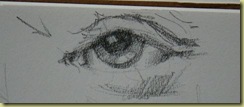
Drawing Eyes – Step-by-Step

I get a little carried away with details sometimes, but this is how I teach my students.


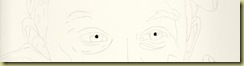
Step 1 – Pupil. I always start my portrait with the pupil of the eye. This is the darkest part of the face.


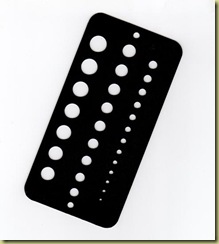
For an eye that is looking straight at you, the iris is perfectly round. A great tool to aid in getting the pupil and iris round is a drill gauge found in a drill set.


Drill Gauge


Using a very sharp 8B or Ebony pencil, lightly fill in the pupil area. I choose not to press heavy for this because the graphite will create a sheen with heavy pressure. So, a couple of light layers of graphite do the trick. This little guy has a highlight on the right side of the pupil, so it will be odd shaped.


Eyes Step 1


Step 1


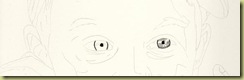
Step 2 - Iris. Iris have dark rims around them, so I start with that area. For this guy I used a 4B pencil. I don’t make a complete circle. I use the parenthesis ( ) technique. The eyelids finish off the iris at the end.


Highlights – Make the highlight larger than it really is. You can always make them smaller later. Once they are too small, it is difficult to make them large again.


Eyes Step 2


Step 2


Step 3 – Blending. Now, I am ready to blend the iris. I take a small blending tortillion. After I blend, I do some minor touch-ups and blend again. I keep blending and touching up until I have the perfect iris.


Eyes Step 3-4


Step 3-4


Step 4 – Whites of Eyes. The whites of our eyes are not pure white. Compare the whites of the eyes with the highlight on the iris. See? The highlight will be whiter. I either take a 2H pencil or a blender with a lot of graphite on it to create the white areas of the eye. The tear duct will be darker, so a pencil will need to be used for this. If you get the whites too dark, use the kneaded eraser to lighten the area.


**Tip** Sometimes you will notice that the outline drawing on your paper is not drawn accurately. This is where the clear acetate line drawing comes in handy. Place it on top of your drawing to find your place again.


**Tip** Another helpful tool is a value finder. Place one on your photo reference and another on your drawing. This will aid you in getting perfect values on your drawing.

Value Finder


Step 5 – Eyelids. Now for the area around the eye. I darkened the eyelid line with a 2B pencil. Then, with a B pencil, I started in the shadows of the eyelid. Pay close attention where these darker values sit. Is it on the lid or on the brow bone? Keep the eyelid line dark. If it blends in too much, the eye will appear flat.


Taking the same small blender, I blended the eyelid.


Then, I moved to the bottom lid. Remember that our eyelids have thickness to them. Some refer that thickness on the bottom eyelid as an antwalk. Be sure to capture this thickness in your drawing even if your reference doesn’t show it.


After blending, I then moved to the skin area underneath the eye. You are saying “What? What about the eyelashes?” Be patient, they are coming…


Step 5


Step 6 – Eyelashes. Now, for the long awaited eyelashes! Eyelashes are drawn in clumps, not in straight lines.


OOPS…before we go to the eyelashes. (I’m sorry.) I forgot to tell you that are eyelids cast a shadow on our eyes. So, a step or two back…Darken the upper part of the eye and blend.


NOW, the eyelashes! The top lashes are usually darker than the bottom lashes. I took a very sharp 4B pencil to create the lashes.


It is very important to have the skin tones around the eyes complete before putting in the eyelashes.


Step 6

He’s looking rather racoonish, eh?


Next time on The Drawing Board, the nose…